


OPERATION DIADEM MAY 1944
Foreword
This account of Operation Diadem and the advance through the Liri Valley commemorates one of the most decisive and hard-fought chapters of the Italian campaign. It honours the men of XIII Corps, whose endurance, skill, and cooperation broke the Gustav Line and opened the road to Rome.
Through the combined efforts of infantry, armour, artillery, engineers, and signals — and the courage of those who built and crossed the Bailey bridges under fire — the Allies achieved a breakthrough that echoed far beyond Cassino. Their success, timed with the launch of Operation Overlord, helped shape the course of the war in Europe.
This piece stands as a tribute to their professionalism and sacrifice — a reminder that victory was forged not only in grand strategy but in the teamwork and determination of those who fought, built, and endured together in the Liri Valley.
This account of Operation Diadem and the advance through the Liri Valley commemorates one of the most decisive and hard-fought chapters of the Italian campaign. It honours the men of XIII Corps, whose endurance, skill, and cooperation broke the Gustav Line and opened the road to Rome.
Through the combined efforts of infantry, armour, artillery, engineers, and signals — and the courage of those who built and crossed the Bailey bridges under fire — the Allies achieved a breakthrough that echoed far beyond Cassino. Their success, timed with the launch of Operation Overlord, helped shape the course of the war in Europe.
This piece stands as a tribute to their professionalism and sacrifice — a reminder that victory was forged not only in grand strategy but in the teamwork and determination of those who fought, built, and endured together in the Liri Valley.
The engineers of the 8th Indian Division and 4th British Division faced some of the most perilous tasks of the campaign: building Bailey bridges under direct enemy observation and fire. The river crossings were heavily defended, and the work demanded extraordinary courage and precision. Among the key bridges that enabled XIII Corps to break into the Liri Valley were the Amazon, Blackwater, Congo, Oxford, and Plymouth bridges - each constructed under intense pressure to keep the advance moving. These feats of engineering not only allowed armour and supplies to cross but symbolised the ingenuity and determination that defined the Royal Engineers’ role in Italy.
The timing of Operation Diadem was no coincidence. The assault on the Gustav Line was deliberately planned to coincide with the imminent launching of Operation Overlord — D-Day — on 6 June 1944. By drawing German divisions south to defend Italy, the Allies ensured fewer enemy reserves were available to oppose the Normandy landings. The breakthrough at Cassino and the advance through the Liri Valley thus played a vital part in the wider Allied strategy, helping to secure the success of the invasion of Western Europe.
By 25 May 1944, Cassino had fallen and the Gustav Line was broken. The Allies surged forward, capturing Rome on 4 June 1944. Operation Diadem marked the turning point of the Italian campaign — the culmination of months of endurance, cooperation, and courage by soldiers from across the Commonwealth and Allied nations.
The struggle through the Liri Valley remains a symbol of determination and unity, paving the way for the liberation of Italy and the eventual victory in Europe.
The timing of Operation Diadem was no coincidence. The assault on the Gustav Line was deliberately planned to coincide with the imminent launching of Operation Overlord — D-Day — on 6 June 1944. By drawing German divisions south to defend Italy, the Allies ensured fewer enemy reserves were available to oppose the Normandy landings. The breakthrough at Cassino and the advance through the Liri Valley thus played a vital part in the wider Allied strategy, helping to secure the success of the invasion of Western Europe.
By 25 May 1944, Cassino had fallen and the Gustav Line was broken. The Allies surged forward, capturing Rome on 4 June 1944. Operation Diadem marked the turning point of the Italian campaign — the culmination of months of endurance, cooperation, and courage by soldiers from across the Commonwealth and Allied nations.
The struggle through the Liri Valley remains a symbol of determination and unity, paving the way for the liberation of Italy and the eventual victory in Europe.
The Royal Engineers - Bridging the Road to Victory
Under constant shellfire and sniper threat, the Royal Engineers of XIII Corps worked tirelessly to keep the advance alive. Their Bailey bridges - Amazon, Blackwater, Congo, Oxford, and Plymouth - became lifelines across the Rapido and Gari rivers. Each span was built in darkness or smoke, often with casualties among the bridging parties. Their courage and technical mastery ensured that tanks and infantry could press forward, transforming the Liri Valley crossings into one of the finest examples of combat engineering in the Italian campaign.
Under constant shellfire and sniper threat, the Royal Engineers of XIII Corps worked tirelessly to keep the advance alive. Their Bailey bridges - Amazon, Blackwater, Congo, Oxford, and Plymouth - became lifelines across the Rapido and Gari rivers. Each span was built in darkness or smoke, often with casualties among the bridging parties. Their courage and technical mastery ensured that tanks and infantry could press forward, transforming the Liri Valley crossings into one of the finest examples of combat engineering in the Italian campaign.
The Battle Beyond Amazon Bridge
Once the 12th Brigade and supporting armour crossed Amazon Bridge, the battle unfolded with precision and teamwork worthy of a military academy’s study. The crossing marked the moment when planning met execution — every branch working in concert to exploit the breach in the Gustav Line.
The Royal Engineers, having completed the bridge under fire, continued to reinforce the structure and clear routes for tanks and supply vehicles. Artillery batteries laid down a carefully timed barrage ahead of the infantry, suppressing enemy strongpoints and cutting off counter-attacks. Armoured units, including Churchill and Sherman tanks, pushed forward across the newly secured span, using their firepower to silence machine-gun nests and bunkers that had dominated the approaches.
The infantry of 12th Brigade advanced methodically behind the armour, clearing pockets of resistance and securing the high ground that overlooked the valley. Signals detachments maintained vital communication links between forward companies, artillery observers, and headquarters, ensuring that orders and adjustments flowed seamlessly despite the chaos of battle. Forward Observation Officers (FOOs) worked at the very edge of the fighting, calling in precise artillery fire to neutralise enemy positions and guide the advance.
It was a model of combined-arms cooperation — engineers, gunners, tank crews, infantry, and signallers acting as one. The success beyond Amazon Bridge demonstrated how disciplined coordination and courage could turn a hazardous river crossing into a decisive breakthrough. In the words of many who witnessed it, the operation read like a page from a military academy battle plan, executed under the most demanding conditions imaginable.
Once the 12th Brigade and supporting armour crossed Amazon Bridge, the battle unfolded with precision and teamwork worthy of a military academy’s study. The crossing marked the moment when planning met execution — every branch working in concert to exploit the breach in the Gustav Line.
The Royal Engineers, having completed the bridge under fire, continued to reinforce the structure and clear routes for tanks and supply vehicles. Artillery batteries laid down a carefully timed barrage ahead of the infantry, suppressing enemy strongpoints and cutting off counter-attacks. Armoured units, including Churchill and Sherman tanks, pushed forward across the newly secured span, using their firepower to silence machine-gun nests and bunkers that had dominated the approaches.
The infantry of 12th Brigade advanced methodically behind the armour, clearing pockets of resistance and securing the high ground that overlooked the valley. Signals detachments maintained vital communication links between forward companies, artillery observers, and headquarters, ensuring that orders and adjustments flowed seamlessly despite the chaos of battle. Forward Observation Officers (FOOs) worked at the very edge of the fighting, calling in precise artillery fire to neutralise enemy positions and guide the advance.
It was a model of combined-arms cooperation — engineers, gunners, tank crews, infantry, and signallers acting as one. The success beyond Amazon Bridge demonstrated how disciplined coordination and courage could turn a hazardous river crossing into a decisive breakthrough. In the words of many who witnessed it, the operation read like a page from a military academy battle plan, executed under the most demanding conditions imaginable.
| Date | Event | Significance |
| September 1943 |
Allied landings at Salerno |
Beginning of the Italian campaign; advance up the peninsula begins. |
| November 1943 | Battles on the Sangro River |
Establishment of winter defensive lines; slow progress northward. |
| January-March 1944 |
First Battles of Cassino |
Repeated assaults fail to break the Gustav Line; heavy casualties. |
| 11 May 1944 |
Launch of Operation Diadem |
Coordinated Allied offensive to breach the Gustav Line and open the Liri Valley. |
| 11-25 May 1944 |
XIII Corps advance through the Liri Valley |
78th, 8th Indian, and 4th British Divisions push forward; key Bailey bridges — Amazon, Blackwater, Congo, Oxford, and Plymouth — enable the breakthrough |
| 25 May 1944 | Cassino Liberated |
Gustav Line broken; German forces retreat north. |
| 4 June 1944 | Rome Captured |
Strategic victory; culmination of the Italian campaign’s southern phase. |
| 6 June 1944 |
Operation Overlord (D-Day) |
The Italian breakthrough helps draw German divisions south, aiding the success of the Normandy landings. |
Timeline


The River Gari, sometimes known as the Rapido River, was part of the Gustav Line. Photographed 14–15 May 1944. The Amazon Bridge stands shrouded beneath a thick smoke screen, with the Blackwater, Congo, and Cardiff bridge sites similarly masked to its upper left. Along the top left of the image, sweeping smoke screens shield the vital crossings of the 8th Indian Division as the assault unfolds.
IWM Photo: British troops crossing Oxford Bridge in the 8th Indian Divison Sector
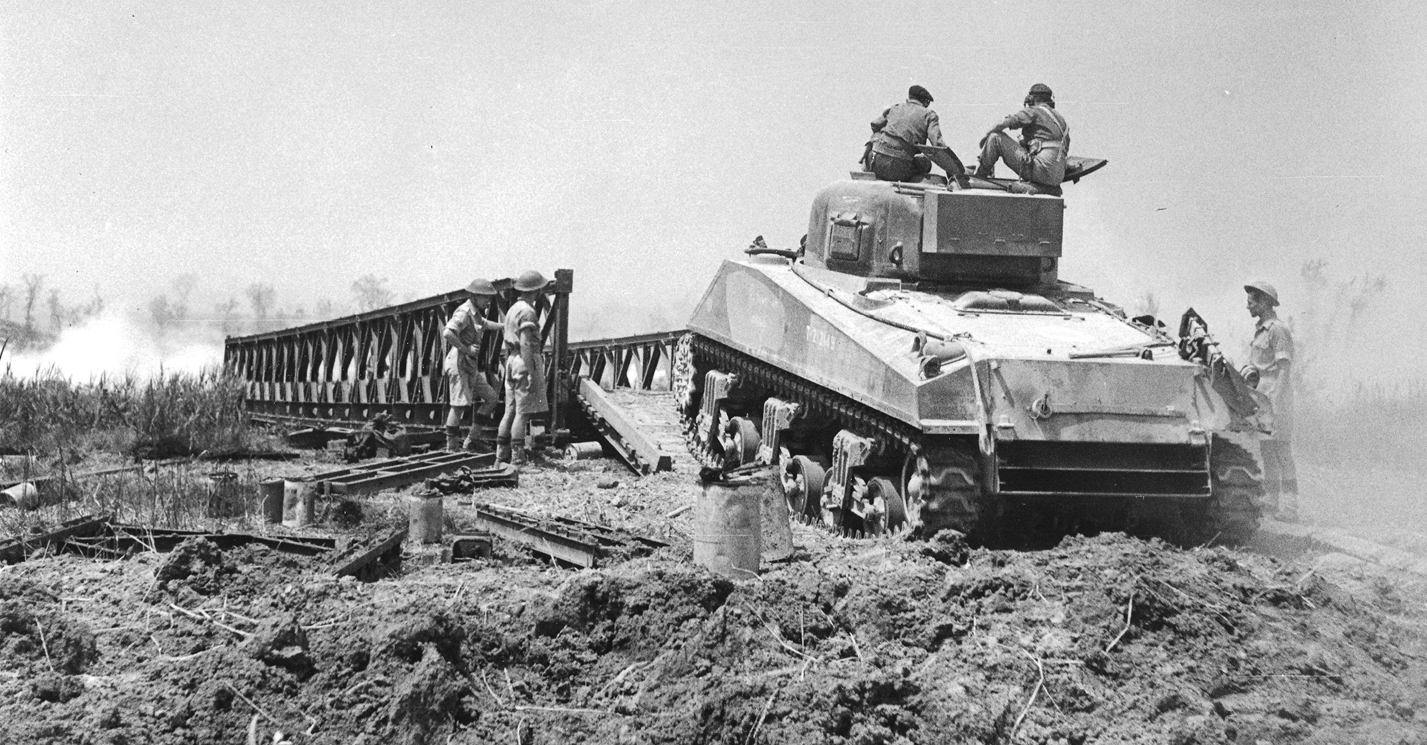
IWM Photo:A Sherman tank crosses Oxford Bridge 14 May 1944 in the 8th Indian Division Sector
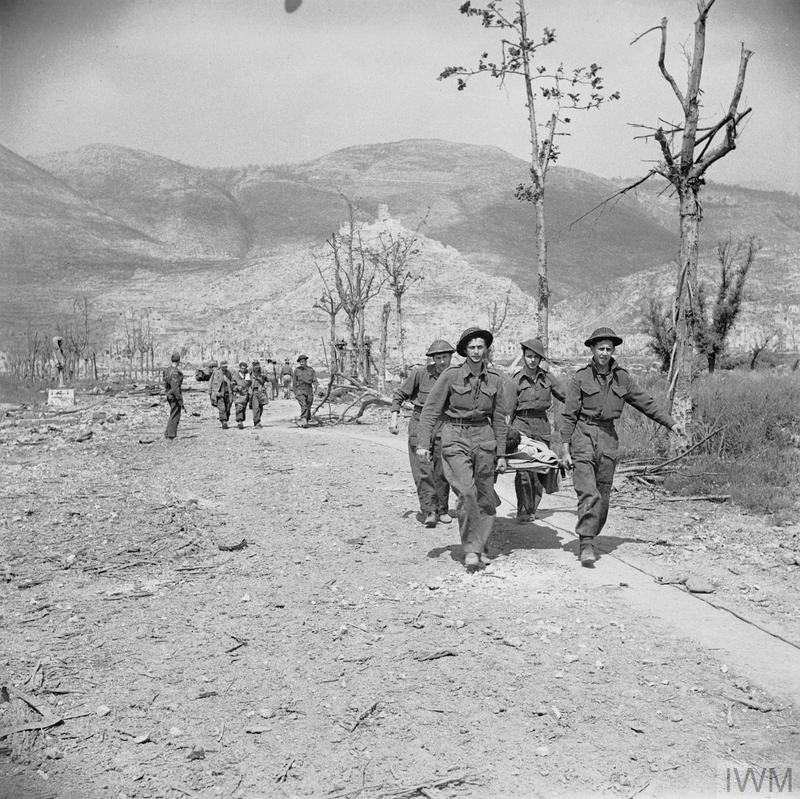
IWM Photo: British troops evacuating the wounded down Route No. 6 in bomb torn Cassino
More photos to follow soon


IWM Photo. “British infantry advancing through dust and smoke during the battle for Monte Cassino, May 1944.”

IWM Photo: Royal Artilley firing a 25 pounder gun during the Fourth Battle for Cassino 15 May 1944.
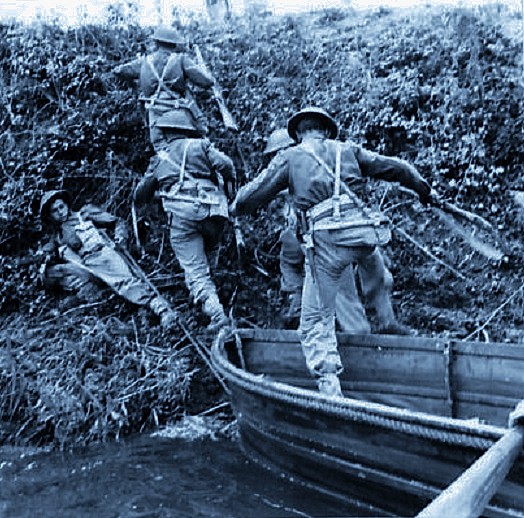
IWM Photo: Operation Diadem — After a forty minute artillery barrage, infantry of XIII Corps began their assault on the Gustav Line, crossing the River Gari in fragile assault boats under fire.
IWM Photo; MK 4 Sherman tanks of the 17th/21st Lancers, 26 Armoured Brigade, 6th Armoured Division advance during the assault on the Gustav Line at Cassino, Italy, 15 May 1944.
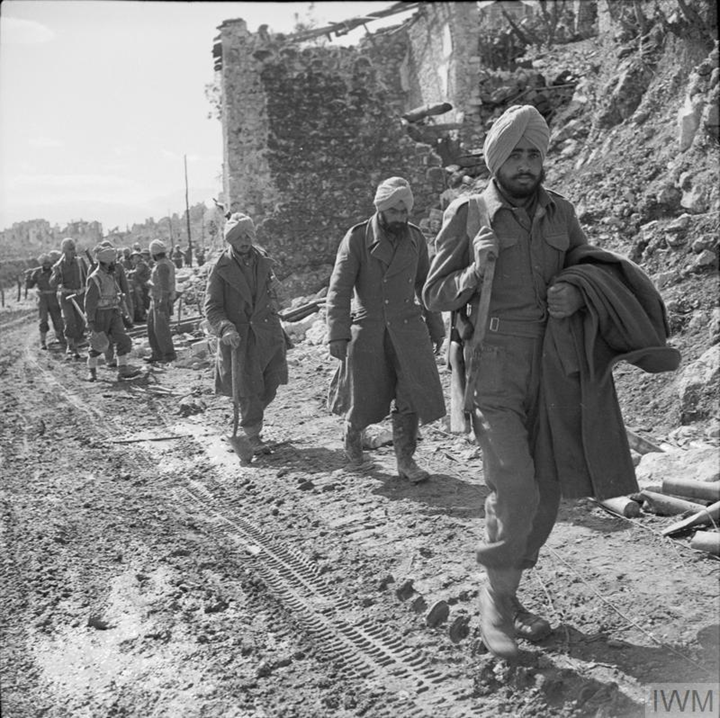
IWM Photo. Taken March 1944. Indian Troops of the 4th Indian, in Cassino

IWM Photo: Photographer: British official war photographer (often from No. 2 Army Film & Photographic Unit).
Date: February 1944.
Description: “Ruins of the Benedictine monastery at Monte Cassino after the Allied bombardment.”
Location: Monte Cassino, Italy.
Collection: War Office Second World War Official Collection.
Date: February 1944.
Description: “Ruins of the Benedictine monastery at Monte Cassino after the Allied bombardment.”
Location: Monte Cassino, Italy.
Collection: War Office Second World War Official Collection.

IWM Photo: A soldier of the Duke of Cornwall’s Light Infantry smiles for the camera near Cassino.

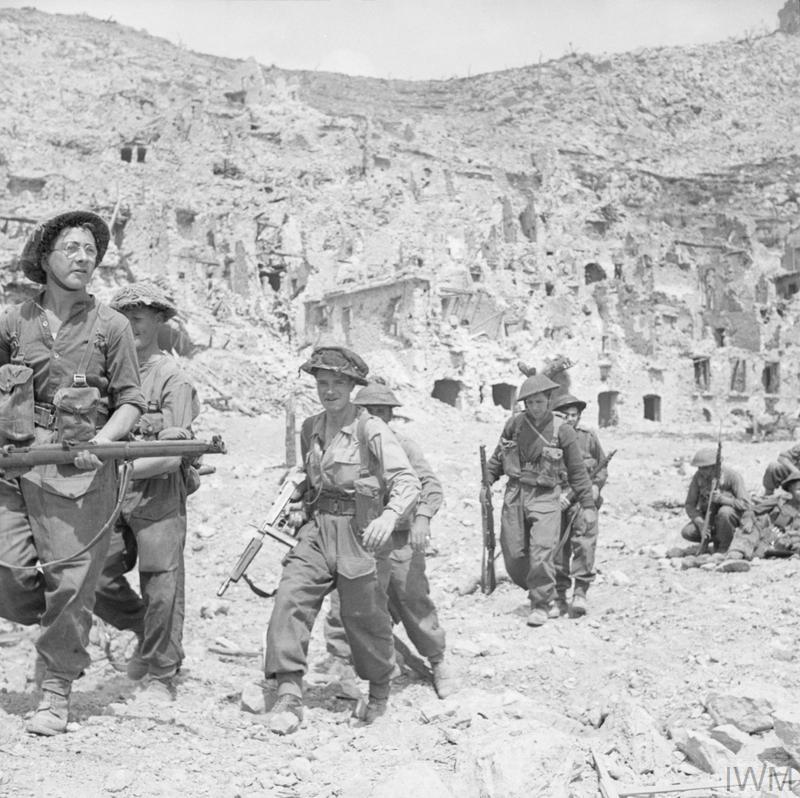
IWM Photo: Men of the 1/6th East Surreys help clear stray snipers in the ruins of Cassino 18 May 1944


Operation Diadem and the Advance through the Liri Valley
The Allied campaign up the Italian peninsula was a long, punishing climb - from the landings at Salerno in September 1943, through the winter battles on the Volturno and the Sangro, to the shattered ruins of Cassino. Each advance was met by fierce German resistance and the challenges of mountainous terrain, rain, and mud.
By spring 1944, the Allies were poised for a decisive strike. Operation Diadem, launched on 11 May 1944, aimed to break the Gustav Line, liberate Cassino, and open the road to Rome. The operation brought together four corps under the Allied 15th Army Group: XIII Corps, II Polish Corps, II US Corps, and I Canadian Corps.
Within XIII Corps, the 78th Division, 8th Indian Division, and 4th British Division advanced through the Liri Valley, driving north from the Rapido River toward Pontecorvo and Aquino. Their progress was hard-won - crossing rivers under fire, breaching minefields, and overcoming entrenched positions. To their left, I Canadian Corps pushed toward the Melfa River, linking with British forces as the German line began to collapse.
The Allied campaign up the Italian peninsula was a long, punishing climb - from the landings at Salerno in September 1943, through the winter battles on the Volturno and the Sangro, to the shattered ruins of Cassino. Each advance was met by fierce German resistance and the challenges of mountainous terrain, rain, and mud.
By spring 1944, the Allies were poised for a decisive strike. Operation Diadem, launched on 11 May 1944, aimed to break the Gustav Line, liberate Cassino, and open the road to Rome. The operation brought together four corps under the Allied 15th Army Group: XIII Corps, II Polish Corps, II US Corps, and I Canadian Corps.
Within XIII Corps, the 78th Division, 8th Indian Division, and 4th British Division advanced through the Liri Valley, driving north from the Rapido River toward Pontecorvo and Aquino. Their progress was hard-won - crossing rivers under fire, breaching minefields, and overcoming entrenched positions. To their left, I Canadian Corps pushed toward the Melfa River, linking with British forces as the German line began to collapse.
From the Liri Valley to Rome
The success beyond Amazon Bridge was more than a local victory - it was the key that unlocked the Liri Valley. With the crossings secure and the German defences collapsing, XIII Corps pressed forward in unison, driving the enemy from one strongpoint to the next. The coordination between engineers, artillery, armour, infantry, and signals had transformed a perilous river assault into a sustained advance.
Each mile gained brought the Allies closer to Rome and closer to the wider strategic goal. The breaking of the Gustav Line was timed to coincide with the imminent launch of Operation Overlord, ensuring that German forces were stretched between two fronts. The men who fought through the Liri Valley thus played their part in the grand design - their courage and precision helping to secure the success of the Normandy landings and the liberation of Western Europe.
From the shattered banks of the Rapido to the gates of Rome, the soldiers of XIII Corps demonstrated how discipline, cooperation, and sheer determination could turn a battle plan into history.
The success beyond Amazon Bridge was more than a local victory - it was the key that unlocked the Liri Valley. With the crossings secure and the German defences collapsing, XIII Corps pressed forward in unison, driving the enemy from one strongpoint to the next. The coordination between engineers, artillery, armour, infantry, and signals had transformed a perilous river assault into a sustained advance.
Each mile gained brought the Allies closer to Rome and closer to the wider strategic goal. The breaking of the Gustav Line was timed to coincide with the imminent launch of Operation Overlord, ensuring that German forces were stretched between two fronts. The men who fought through the Liri Valley thus played their part in the grand design - their courage and precision helping to secure the success of the Normandy landings and the liberation of Western Europe.
From the shattered banks of the Rapido to the gates of Rome, the soldiers of XIII Corps demonstrated how discipline, cooperation, and sheer determination could turn a battle plan into history.
BRITISH XIII CORPS AREA

The British 4th Division's objectives, Brown Line, Blue Line, Red Line and the Green Line


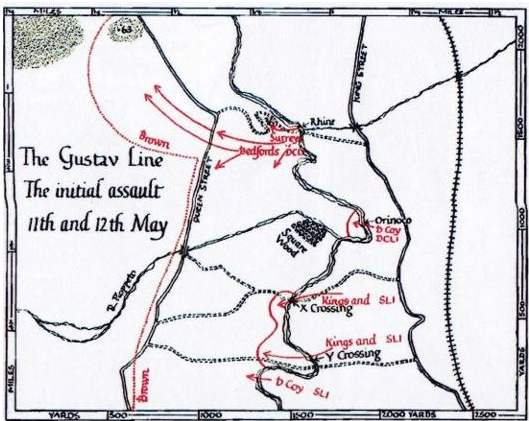
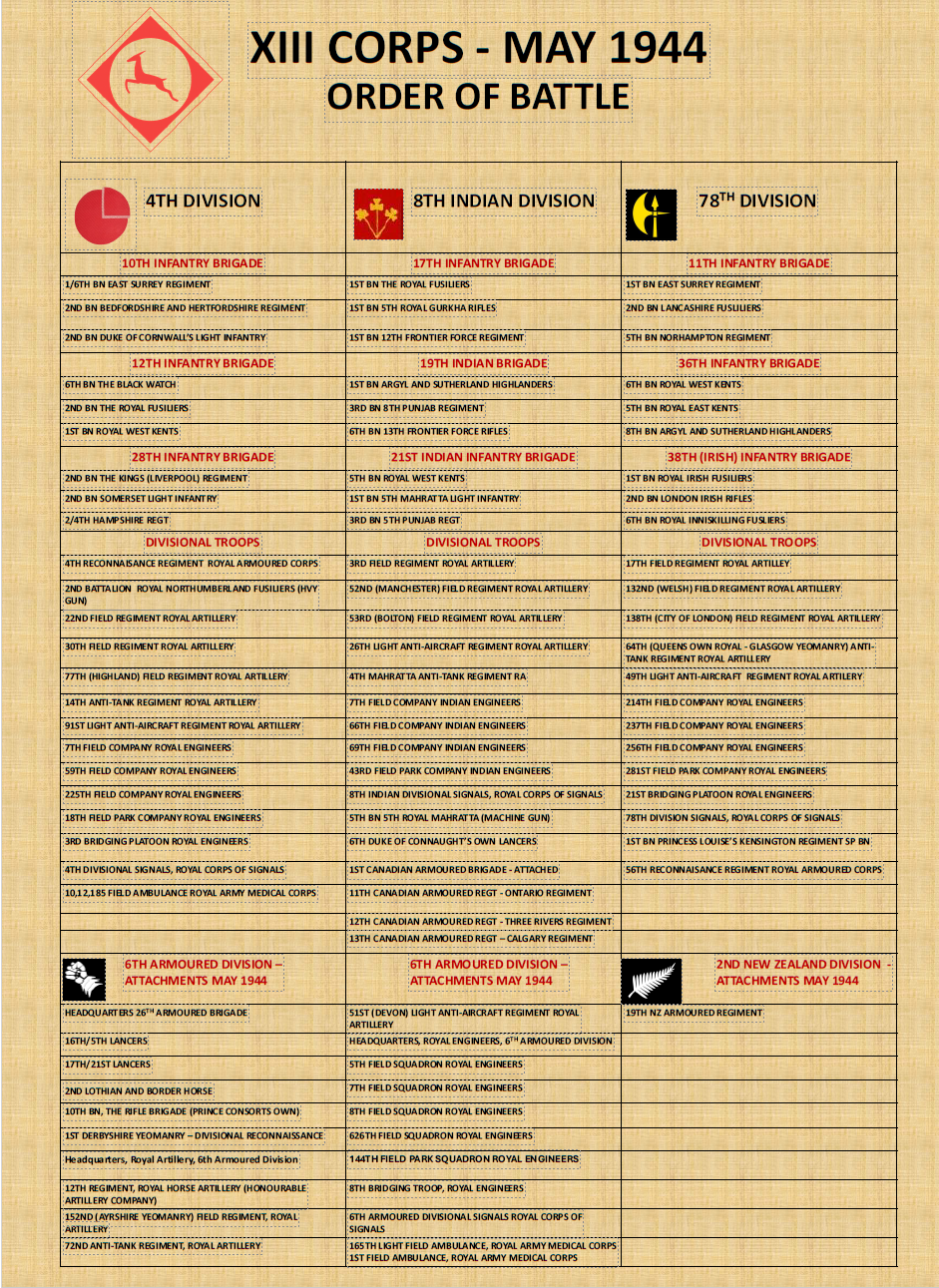
The (Br) 4th Division's Initial Assault with the 10th and 28th Brigades
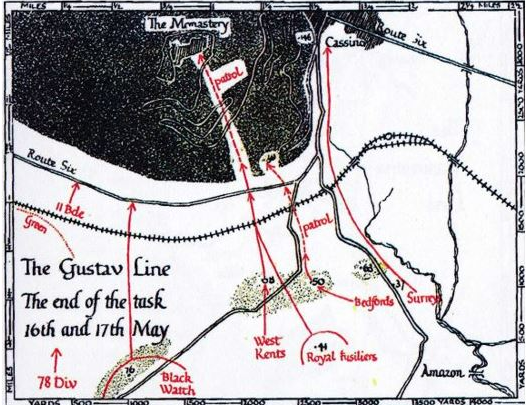
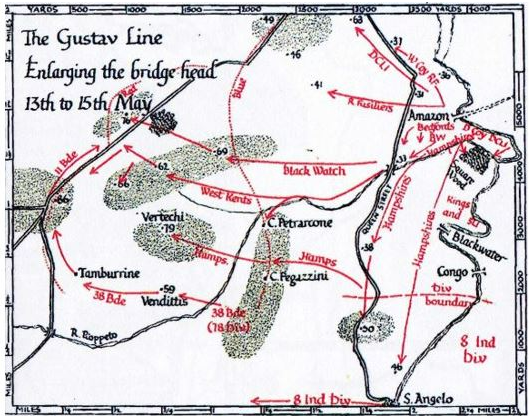
13 May — The Bailey bridge known as the ‘Amazon’ is opened, enabling the 4th Division’s reserve formation, 12 Brigade, to cross the river and save, expand, and push the bridgehead forward.
The 4th Division’s main positions, 16–18 May. After a brief attachment to the 78th Division and the 8th Indian Division, 12 Brigade continued in the battle before leaving the field on 20 May 1944.
The 78th Division had it's own reporting lines:
Grafton (Red Line), Pychley, Bedale (Green Line) and the Fernie Line — The 78th Division’s forward positions in the Liri Valley, 17–18 May 1944. Established beyond Bedale as the division’s final consolidation line before the assault on the Hitler Line.
Grafton (Red Line), Pychley, Bedale (Green Line) and the Fernie Line — The 78th Division’s forward positions in the Liri Valley, 17–18 May 1944. Established beyond Bedale as the division’s final consolidation line before the assault on the Hitler Line.
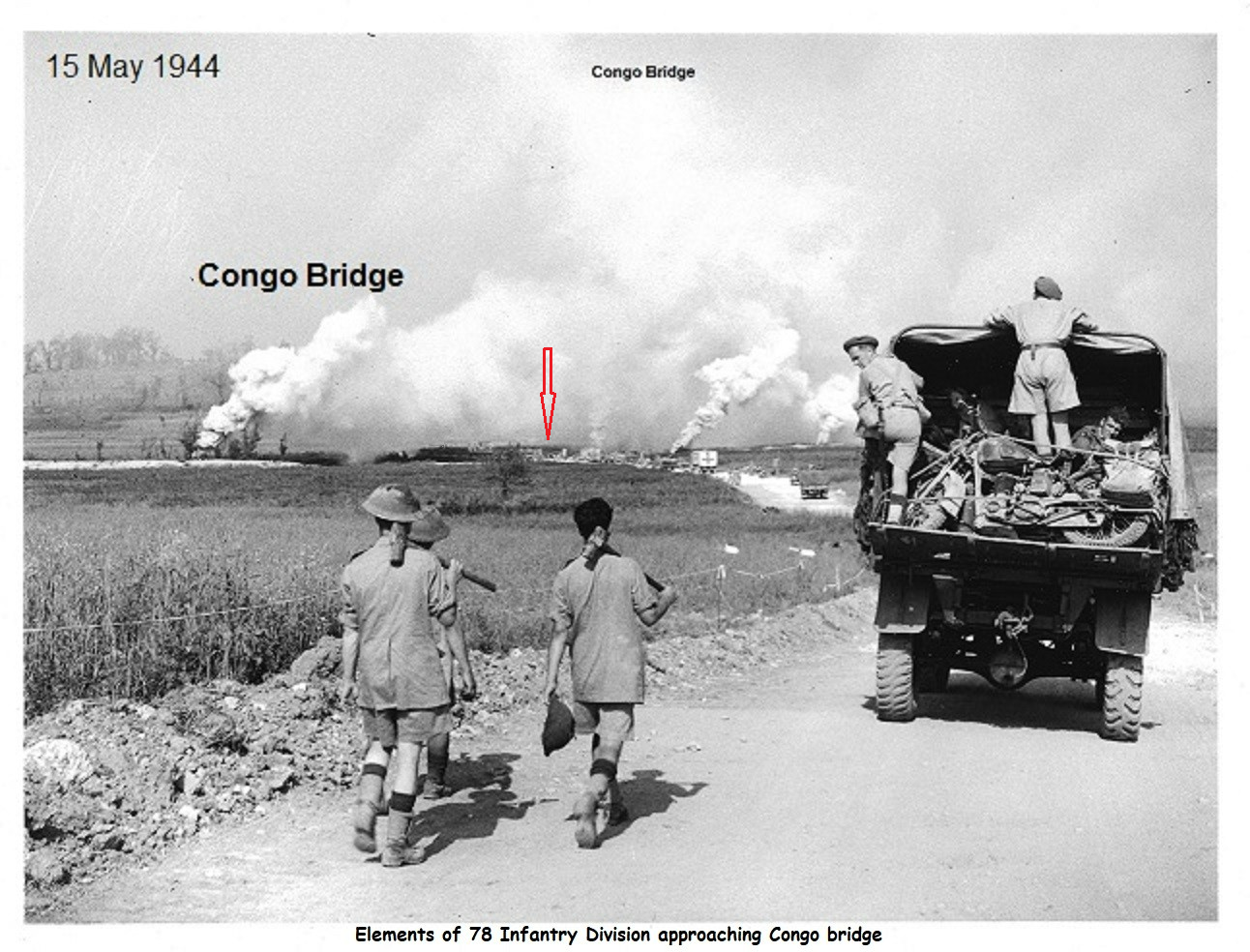
On 14 May, elements of 78 Division began moving up behind the 4th Division’s forward brigades.
Overnight 14/15 May, the division completed the passage of lines through the 4th Division’s front.
By 15 May, 78 Division was advancing on the Grafton–Pychley–Bedale reporting lines, supporting the wider Allied envelopment behind Monte Cassino.
Overnight 14/15 May, the division completed the passage of lines through the 4th Division’s front.
By 15 May, 78 Division was advancing on the Grafton–Pychley–Bedale reporting lines, supporting the wider Allied envelopment behind Monte Cassino.
Photo Credits Warfare History Network.
A Canadian soldier pauses to inspect a panzerturm, the turret of a PzKpfw. V Panther with its 75mm cannon mounted in a fixed position, such as this concrete bunker. Such defences were encountered during the assault against the Hitler Line.
A Canadian soldier pauses to inspect a panzerturm, the turret of a PzKpfw. V Panther with its 75mm cannon mounted in a fixed position, such as this concrete bunker. Such defences were encountered during the assault against the Hitler Line.

During the night of 15–16 May, Lieutenant General Leese ordered 1 Canadian Corps forward through the sector of 8 Indian Division.
By 16 May, Canadian units were fully committed in the valley, signalling to the Germans that the Allies had brought fresh forces into the battle and that the main blow was shifting toward the Hitler Line.
Their assault on the line itself began on 23 May
By 16 May, Canadian units were fully committed in the valley, signalling to the Germans that the Allies had brought fresh forces into the battle and that the main blow was shifting toward the Hitler Line.
Their assault on the line itself began on 23 May
The Fall of the Hitler Line — 23–25 May 1944. After breaking through the Gustav Line, 1 Canadian Corps launched its assault on the Hitler Line at dawn on 23 May 1944, supported by the British 78th Division and Polish II Corps. Following intense fighting around Pontecorvo and Aquino, the line was finally breached, opening the Liri Valley to the Allied advance. Two days later, on 25 May, Polish troops captured Piedimonte San Germano, completing the collapse of the German defences and securing the route north toward Rome.


Piedemonte on the Hitler Line May 1944

Photo Credits Warfare History Network.
Canadian armoured vehicles advance cautiously during the attack on the Hitler Line in the spring of 1944. This photograph was taken as the troops and tanks crossed open ground near Aquino.
Canadian armoured vehicles advance cautiously during the attack on the Hitler Line in the spring of 1944. This photograph was taken as the troops and tanks crossed open ground near Aquino.
IWM Photo: A tank armoured turret dug in the ground on the Hitler Line with Piedemonte San Germano in the background. May 1944
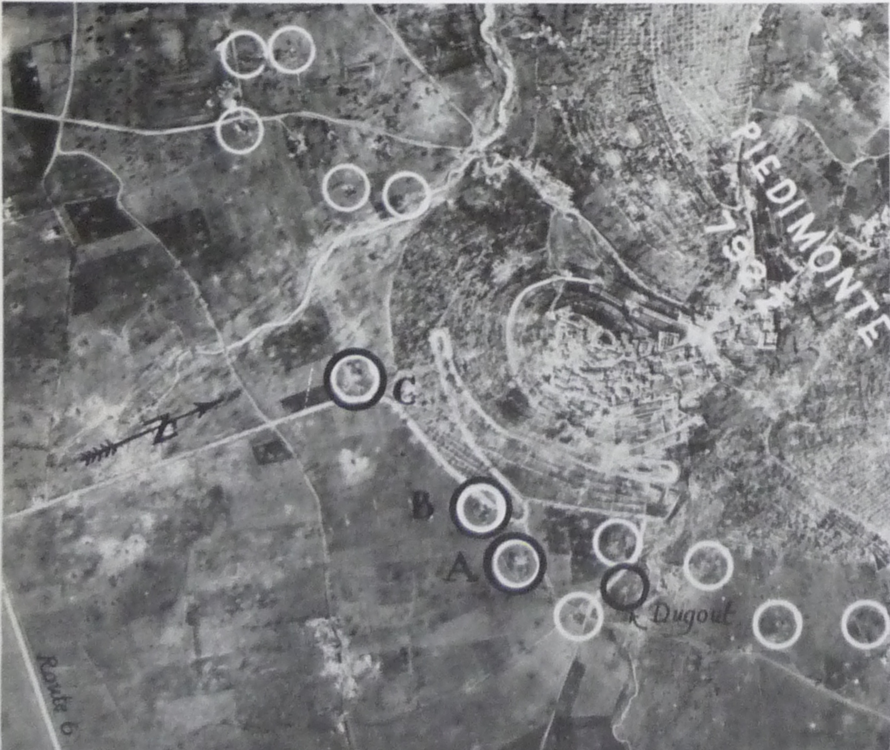
IWM Photo: Marked Defences on the Hitler Line in Piedemonte area. Photo taken February 1944
British Movietone.
13 Corps Area
(22 May 1944) The battle for Rome is being resumed in full force. This story shows British and Indians cracking through the Gustav Line.
The first River Gari Battlefield Tour video. It marks all the 4th Division’s assault crossing points from Cassino to Sant’Angelo — including the infantry boat crossings and the Bailey bridge sites. This is a unique Battlefield tour that is rarely covered in such detail on the assault on the Gustav Line in the Fourth Battle for Cassino. This video identifies the exact locations, so it’s a useful reference for anyone interested in the ground and for future ABMA/ADVENTURELAND River Battlefield Tours.

The above video is very useful for the Gustav Line Battles Orientation